


Choosing the mesh and screen tension
In short: the mesh count (threads per cm) largely determines ink deposit and detail: a fine mesh deposits little ink and renders fine details, while a coarse mesh deposits a lot of ink for solid areas and textiles. Screen tension, in turn, controls sharpness, registration and the screen's lifespan.
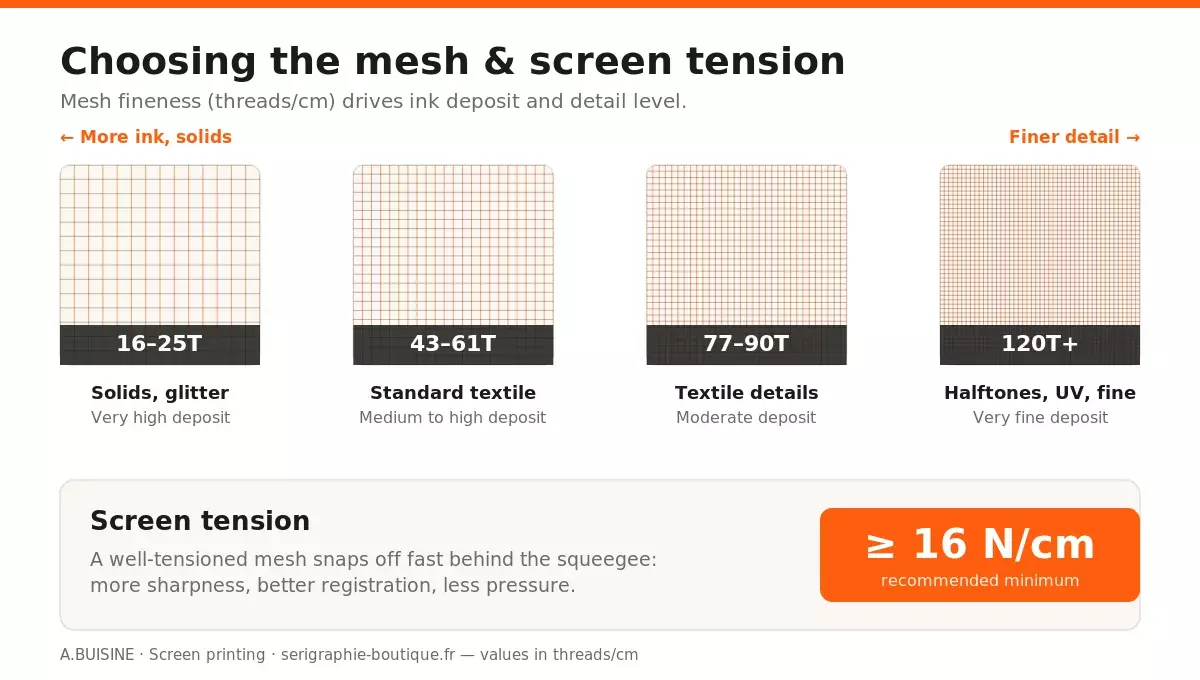
So you choose the mesh to suit the substrate you want to print, but also the type of ink you will use.
The steps
1. Define the target result
Textile solid area, fine details, thick ink (puff), process (CMYK), or special inks (glitter, for example).
2. Choose the mesh accordingly
Coarse mesh for textile solids, fine mesh for details.
3. Check the screen tension
With a tension meter; target value in N/cm depending on the frame and mesh.
4. Record the validated mesh + tension pair
So you can reuse it on your next prints.
Recommended mesh by use
| Use | Starting mesh | Deposit / result | Setup notes |
|---|---|---|---|
| Glitter, large pigments | 16T-25T | Very high deposit | Check the grain size: the pigment must pass without clogging the mesh. |
| Puff, high density, very opaque white | 32T-43T | High deposit | Often used with 15-20% EOM and a 60-70 shore squeegee. |
| Standard textile solids | 43T-61T | Medium to high deposit | Good starting point for cotton, plastisol or opaque water-based ink. |
| Textile details, colours on a white base | 77T-90T | Moderate deposit | Improves hand feel and sharpness, and reduces fibrillation. |
| Halftones, textile CMYK, fine paper | 90T-120T | Fine deposit | Pair with a dense film, good tension and a 75-80 shore squeegee. |
| UV, labels, smooth substrates, electronics | 120T+ | Very fine, controlled deposit | Requires high tension, a clean environment and a suitable ink. |
Frequently asked questions
Which mesh for a t-shirt?
For a textile solid, start around 43-61 threads/cm; for an opaque white or a puff, go down to 43 threads/cm; for details and halftones, go up to 77T-110T.
Which mesh for which ink?
Match the mesh opening to the ink type, to account for its viscosity but above all its drying in the mesh: the faster an ink dries, the more open a mesh you choose. On textile, for example, use a more open mesh for a water-based ink (43-54) than for a plastisol (54-77).
Why does good tension reduce smearing?
A tensioned mesh snaps off the substrate quickly behind the squeegee, without dragging in the wet ink. It needs less pressure and distorts the image less. Always use a sufficiently tensioned frame, with a suitable off-contact (the gap between screen and substrate).
Why does my tension drop over time?
The mesh slackens naturally with use; a slack frame harms registration and must be re-tensioned or replaced.
Advanced details Screen tension
| Parameter | Recommended baseline | Why |
|---|---|---|
| Tension | > 16 N/cm minimum for effective mesh release after the squeegee stroke | Improves sharpness, registration and peel, and reduces the required pressure. |